
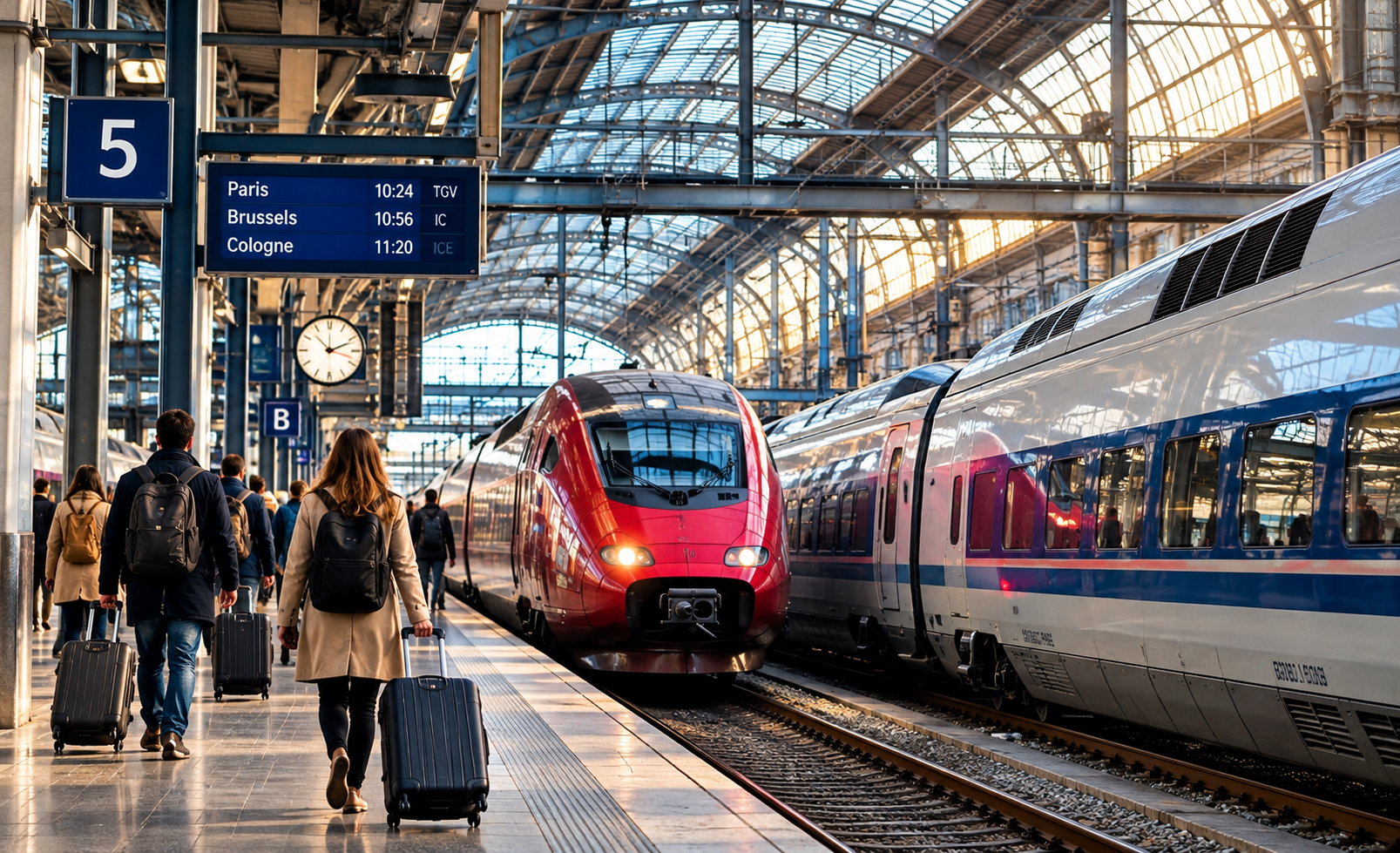
Traveling between countries is one of the great advantages of a trip to Europe.
Paris, Brussels and Cologne can all fit into the same itinerary. Amsterdam can be combined with Belgium and France. Berlin, Prague and Vienna can become one multi-country trip rather than three separate vacations.
If you’re still deciding how many cities to include, start with our guide to planning a multi-city Europe trip without rushing it.
But once you start looking at tickets, something confusing often happens.
The train everyone recommends looks expensive.
Then you find a bus for a fraction of the price.
So should you simply book the bus?
Not necessarily.
The cheapest ticket on the screen is not always the cheapest journey — and trains in Europe are not always the expensive option they first appear to be.
A €15 bus may look better than a €40 train until you discover that it takes several hours longer, leaves from a less convenient location, requires extra local transport, or gives you less flexibility if your plans change.
On the other hand, paying significantly more for a train just to save a small amount of time may make little sense when you’re traveling on a tight budget.
The useful question isn’t:
“Are trains or buses cheaper in Europe?”
It is:
“Which option gives me the best value for this particular journey?”
That is what this guide will help you work out.
The Cheapest Ticket Isn’t Always the Cheapest Journey
When comparing a train and a bus, it is easy to focus on one number: the ticket price.
But the real cost of a journey can include more than the fare.
A cheaper option may involve a longer journey, an inconvenient departure time, extra transport to reach the station or bus stop, additional luggage fees, or less flexibility if your plans change.
Time matters too. Saving €20 may be worthwhile if you have a flexible itinerary. But if the cheaper journey takes four extra hours, those €20 are effectively costing you half a day of your trip.
Before booking, compare five things: ticket price, total travel time, departure and arrival location, luggage conditions, and ticket flexibility.
This simple comparison gives you a much better picture of the real value of each option.
When European Trains Can Be Surprisingly Affordable
European trains have a reputation for being expensive, but that is not always the case.
On many international routes, operators sell a limited number of lower-priced advance fares. If you search early enough and your travel dates are reasonably fixed, the difference between a train and a long-distance bus can be much smaller than expected.
This matters because the train may also give you a faster journey and more convenient departure and arrival points.
For example, Eurostar connects Paris and Brussels city centre to city centre. Deutsche Bahn also offers advance international fares between Belgium and Germany, including connections towards Cologne.
The important detail is that the lowest advertised fares are not guaranteed for every departure or travel date. They depend on availability and can disappear as the cheaper ticket inventory sells.
So when planning a multi-country European trip, don’t check the train once, see an expensive fare and assume that buses will always be cheaper. Compare different departure times and, when your itinerary is fixed, check fares well before the travel date.
When the Bus Really Is the Better Budget Option
Trains are not automatically the best choice either.
On some European routes, long-distance buses can cost significantly less, especially when train fares have already increased or you are booking relatively close to departure.
A bus can make particularly good sense when the price difference is substantial, the journey is not dramatically longer, and the departure and arrival points work well with your itinerary.
It can also be useful when the train route requires inconvenient connections or when you would rather save money than save an hour or two.
But compare the whole journey, not just the fare shown in the search results.
Check where the bus actually departs and arrives, how long the trip takes, what luggage is included, and whether reaching your accommodation will require additional public transport or a taxi.
If a €15 bus saves you €30 but adds several hours and extra local transport, it may still be the right choice — but now you are making that decision with the full cost in mind.
Why Booking Early Matters
One of the easiest mistakes when planning train travel in Europe is assuming that today’s fare will still be available later.
On many international and high-speed routes, the lowest-priced tickets are limited. As those cheaper fares sell out, the price for the same journey can rise — even though the train itself has not changed.
This is why travelers comparing a train and a bus several months before departure may see a very different price relationship from someone searching only a few days before traveling.
But booking early does not mean booking blindly.
Before committing to the cheapest advance fare, make sure your travel date and itinerary are reasonably settled. Lower-priced tickets can come with stricter conditions for changes or cancellations.
A useful rule is simple: once your itinerary is firm, start comparing the available fares rather than waiting for an assumed last-minute bargain.
For trips around particularly busy travel periods — including Christmas and New Year — checking earlier becomes even more important because popular departures can have less low-fare availability.
Cheap Fares vs Flexible Fares
The lowest fare can come with a trade-off: less flexibility.
Before choosing the cheapest ticket, check what happens if you need to change your departure time, move the trip to another day, or cancel altogether.
Different operators — and even different fare types from the same operator — can have very different conditions.
Some discounted tickets may be tied to a specific train and have strict change or cancellation rules. A more expensive fare may allow greater flexibility.
That does not mean you should automatically pay extra for a flexible ticket.
If your itinerary is fixed — for example, your accommodation is booked and you know exactly when you want to travel — a restricted advance fare may be perfectly reasonable.
If your plans are still uncertain, however, saving a small amount on the ticket can become expensive if you later have to buy a completely new one.
Before paying, check three things: Can I change this ticket? Can I cancel it? What will either option cost me?
Treat flexibility as part of the price rather than an optional detail.
Don’t Forget the Luggage
Luggage can change the real cost of a journey, especially when two tickets initially look similar in price.
Train and bus operators do not all use the same baggage rules. What is included, how much you can bring, and whether additional luggage costs extra depends on the operator and sometimes on the type of service.
This matters particularly on a multi-country trip, when you may be traveling with a suitcase rather than just a small backpack.
Before booking, check the operator’s current luggage allowance rather than assuming that the rules will be the same as on another train, bus or airline.
Also think about practicality. Carrying a large suitcase through several connections, across a large station, or to a bus departure point can make a seemingly convenient itinerary much less comfortable.
Compare the journey with the luggage you will actually be carrying — not with an imaginary traveler carrying only a backpack.
If additional baggage fees apply, add them to the ticket price before deciding which option is genuinely cheaper.
City-Centre Station vs Out-of-Centre Stop
Two journeys with similar ticket prices can have very different costs once you look at where they actually begin and end.
Many European rail routes connect major city-centre stations. That can mean arriving within walking distance of your accommodation or with an easy connection to local public transport.
Long-distance buses can also use central locations, but this varies by city and service. Some stops may be farther from the area where you are staying.
Before booking, put the exact departure and arrival points into a map and check how you will get to and from them.
A cheaper ticket can lose part of its advantage if you need extra metro, bus or taxi journeys at either end. An inconvenient departure point can also mean leaving your accommodation much earlier than the timetable alone suggests.
The same applies to time. Compare the journey door to door, not simply the scheduled time between departure and arrival.
Ticket price + local transport + total door-to-door time gives you a much more realistic comparison.
Separate Tickets and the Missed-Connection Trap
Buying separate tickets can sometimes make a journey cheaper, but it can also change what happens if something goes wrong.
Imagine that your trip requires two trains. You buy each leg separately because the combination costs less. The first train is delayed, and you miss the second.
Whether you are protected in that situation can depend on how the journey was ticketed.
Under EU rail passenger-rights rules, passengers traveling on a through-ticket have protections when a delay causes a missed connection. If the expected delay at the final destination is 60 minutes or more, this can include the choice between reimbursement and continuing or rerouting the journey under the applicable conditions.
If you are traveling on individual tickets rather than a through-ticket, these EU missed-connection rights do not apply in the same way. However, some railway companies have separate arrangements that may still help passengers continue their journey after a missed connection.
That does not mean you should never split a journey into separate bookings. Sometimes the saving is worthwhile. But before doing it, understand what you are giving up and leave a sensible connection margin if the tickets are independent.
A small saving is less attractive if one delay can leave you buying a new last-minute ticket.
When comparing options, check whether your itinerary is sold as one through-ticket or as separate transport contracts — especially when changing trains or operators.
Case Study: Paris → Brussels → Cologne
Let’s put the comparison into practice.
Imagine you’re planning a first multi-country trip to Europe and want to travel from Paris to Brussels and then on to Cologne.
At first glance, you might search for a Paris–Brussels train, see a fare that looks expensive, and decide that buses must be the budget option for the entire route.
A better approach is to compare each leg separately — because the best-value option does not have to be the same for both journeys.
Price note: The fares mentioned below were checked in October 2026 and are examples of advertised starting fares, not guaranteed prices. Transport fares, availability, schedules and ticket conditions can change, so always check the operator’s current information for your travel date before booking.
Paris → Brussels
Eurostar operates the direct high-speed rail connection between Paris and Brussels.
As of our October 2026 check, Eurostar advertises entry-level Standard fares on this route from around €29 one way, subject to availability. These are starting fares, not a price you should expect to find on every date or departure.
The train has another important advantage for this particular journey: it connects Paris Gare du Nord with Brussels-Midi/Zuid, so the comparison is not simply train fare versus bus fare. Journey time and the location of the departure and arrival points matter too.
Long-distance buses can be substantially cheaper on some dates. For example, FlixBus advertises low starting fares on Paris–Brussels, but actual prices vary with the date and departure.
So for this leg, check both options before booking. If the train is only moderately more expensive on your travel date, the shorter journey and convenient rail stations may justify the difference. If the price gap is large and you have plenty of time, the bus may provide better value.
Brussels → Cologne
For the second leg, don’t assume that you need to keep using the same operator or the same type of transport.
Deutsche Bahn (DB) operates international ICE connections between Belgium and Germany, including Brussels and Cologne.
As of our October 2026 check, Deutsche Bahn advertises Super Saver Europe Belgium fares between Germany and Belgium from €19.99, subject to availability. This is a starting fare for the wider Germany–Belgium offer, not a guaranteed €19.99 fare for Brussels → Cologne. DB currently operates multiple daily ICE connections between Germany and Brussels via Liège, and tickets for this offer can be available up to 12 months in advance.
Again, the starting fare is not a promise that €19.99 will be available for your particular date or train. It is a reason to check the rail option before assuming that a bus will automatically be cheaper.
There is also an important trade-off. DB’s lowest Super Saver fares are restrictive. Under the current conditions, they generally cannot be exchanged or cancelled after purchase, apart from DB’s short instant-cancellation window following an online booking.
If your plans are fixed, that restriction may be perfectly acceptable in exchange for a lower fare. If your itinerary could change, compare the conditions of the available fare types before choosing purely on price.
The lesson from this route is simple: Paris → Brussels → Cologne does not have one universally cheapest transport option. Compare each leg on your actual travel dates, then consider price, journey time, location, luggage and flexibility together.
A Simple Booking Method for First-Time Europe Travelers
You don’t need to understand every European rail and bus network before planning a multi-country trip. You just need a consistent way to compare your options.
For each journey between cities, use this simple process:
1. Search the route for your actual travel date.
Don’t rely on a fare you saw in a blog post or on someone else’s trip. Prices and availability change.
2. Check the train option with the relevant operator.
Look at the journey time, fare conditions and arrival station — not only the price.
3. Check a long-distance bus option.
Compare the saving with the additional travel time and the exact departure and arrival points.
4. Add any extra costs.
Include luggage fees where applicable and any local transport needed to reach your accommodation.
5. Check the ticket conditions before paying.
Know whether the fare can be changed or cancelled and what happens if you miss a connection.
6. Compare door to door.
Ask yourself how much the entire journey costs and how much of your travel day it uses.
Then make the decision that fits your budget and your itinerary, rather than automatically choosing the cheapest ticket.
For one journey, that may be the bus. For the next, an advance train fare may offer much better value.
Final Checklist Before You Book
Before paying for a train or bus ticket between European cities, take one final minute to check:
- Total price: Is this the final fare, including any luggage or booking costs that apply?
- Travel time: How long will the journey really take?
- Departure point: How will you get there from your accommodation?
- Arrival point: How far is it from where you actually need to go?
- Luggage: Is your suitcase included, and are there size or quantity limits?
- Flexibility: Can you change or cancel the ticket if your plans change?
- Connections: Is the journey covered by one ticket, or are you relying on separate bookings?
- Timing: Are you comparing realistic departures, rather than choosing an inconvenient time simply because it is cheapest?
If one option still looks substantially cheaper after all of those checks, you have a much stronger reason to choose it.
The goal isn’t to find the cheapest ticket in Europe. It’s to avoid paying more — in money or valuable travel time — than the journey is worth to you.
Train or Bus? Choose for the Journey, Not the Label
There is no single answer to whether trains or buses are cheaper for traveling between European countries.
Sometimes an advance train fare gives you the best combination of price, speed and convenience. On another route — or even on another departure the same day — a long-distance bus may save enough money to make the extra travel time worthwhile.
The important thing is not to decide in advance that one type of transport is always cheaper.
Compare the actual options for your date, look beyond the headline fare, and consider what the journey will cost you door to door — in both money and time.
Do that for each leg of a multi-country itinerary, and you can keep your transport budget under control without automatically sacrificing convenience just to find the lowest ticket price.
Planning your first trip around Europe? Save this guide and use the checklist each time you compare a new route.
Sources & Current Information
Transport fares, schedules and ticket conditions can change. The information in this guide was checked against official sources in October 2026.
Official sources used: Eurostar, Deutsche Bahn (DB), FlixBus and the European Union’s Your Europe passenger-rights guidance.
Eurostar — Paris to Brussels trains and fares
Deutsche Bahn — Super Saver Fare Europe Belgium
FlixBus — Paris to Brussels bus
Your Europe — Rail passenger rights
Planning More of Your Trip?
Planning your trip involves more than getting from one city to another. Our free Traveler’s Handbook brings together practical guidance to help you plan the rest of your journey with more confidence.
Get the free Traveler’s Handbook →
Once your route and transport are sorted, the next step is deciding what is actually worth booking along the way. You can browse our curated travel experiences and tours for ideas across European destinations.